
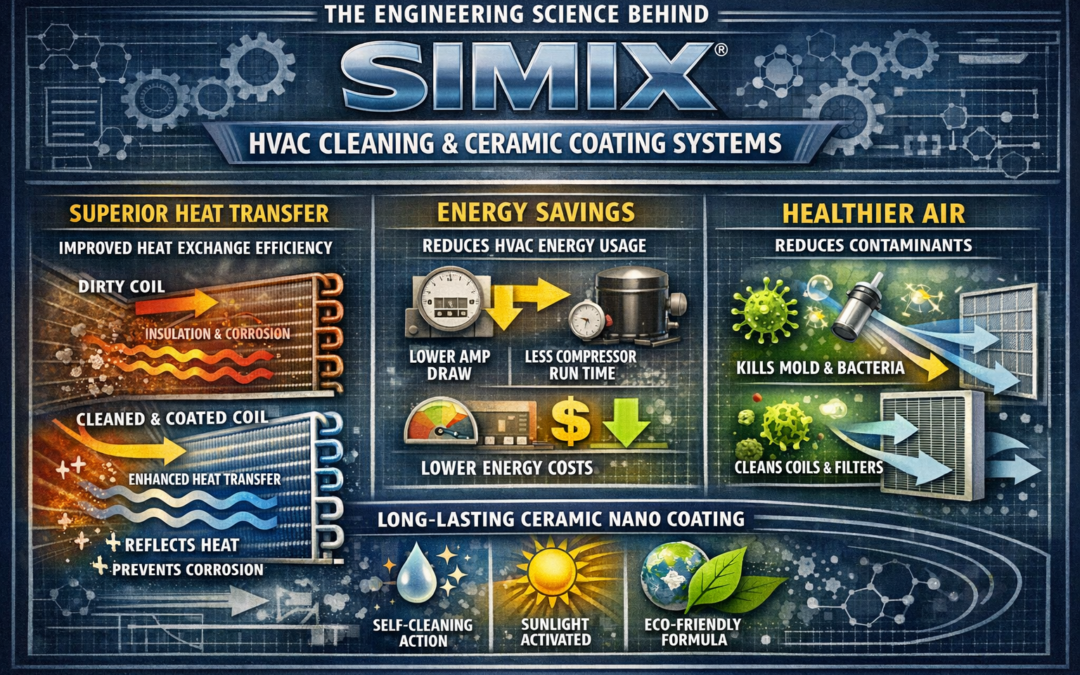
Why advanced chemistry and surface engineering translate into measurable energy, durability, and lifecycle gains
Introduction: When Surface Science Becomes an Energy Strategy
In commercial and institutional buildings, HVAC efficiency is rarely limited by design intent—it is limited by surface condition. Fouled coils, degraded heat-exchange surfaces, and recurring contamination quietly erode performance year after year, driving up kWh consumption, shortening equipment life, and increasing maintenance burden.
SIMIX Products address this problem at its root. Rather than treating cleaning and protection as separate, short-term maintenance tasks, SIMIX applies formulation chemistry, materials science, and heat-transfer engineering to create an integrated system: a high-efficacy cleaner/degreaser followed by a functional ceramic clearcoat engineered specifically for HVAC and industrial heat-exchange environments.
This article explains—without marketing fluff—how SIMIX products work, why they perform differently from conventional alternatives, and how their technical attributes translate into real-world operational advantages for engineers, facility managers, and informed buyers.
Understanding the Technical Foundation
HVAC Performance Is a Surface Chemistry Problem
Heat transfer in HVAC coils depends on three controllable factors:
- Surface cleanliness (absence of oils, biofilms, and particulate fouling)
- Surface energy and wettability (how condensate forms and evacuates)
- Thermal resistance at the air–metal interface
Traditional maintenance focuses almost exclusively on item #1—and even then, only temporarily. SIMIX products are engineered to address all three simultaneously.
The SIMIX Cleaning System: Chemistry With a Purpose
Advanced Oxidative & Surfactant Synergy
SIMIX cleaners are formulated using a controlled oxidative chemistry combined with engineered surfactant systems. This dual-action approach allows the cleaner to:
- Break down hydrocarbon oils and greases
- Disrupt biological films and organic residues
- Lift and suspend particulate matter for complete removal
Unlike harsh acids or caustic cleaners, SIMIX formulations are designed to achieve high soil-removal efficiency without attacking base metals, coil fins, or protective factory coatings when applied as directed.
Why this matters:
Incomplete or aggressive cleaning leaves residues, etches fins, or accelerates corrosion—each of which increases long-term thermal resistance.
Residue-Free Rinsing and Surface Reset
A critical but often overlooked attribute of HVAC cleaners is post-clean surface condition.
SIMIX cleaners are engineered to rinse clean, leaving:
- No sticky surfactant films
- No ionic residues that attract airborne contaminants
- A neutralized surface suitable for coating adhesion
This “surface reset” is essential for the next engineering step: functional coating application.
SIMIX Ceramic Clearcoat: Functional Surface Engineering
Thin-Film Ceramic Chemistry (Not a Cosmetic Coating)
The SIMIX Ceramic Clearcoat is not a cosmetic sealant. It is a thin, inorganic-organic hybrid ceramic layer designed to modify surface behavior at the microscopic level.
Key formulation characteristics include:
- Extremely low film thickness (microns, not mils)
- High adhesion to aluminum, copper, and steel substrates
- Non-insulating ceramic matrix that avoids thermal penalty
Based on industry-standard thin-film ceramic behavior, coatings at this thickness do not measurably impede heat transfer when properly applied.
Surface Energy Modification & Condensate Dynamics
One of the most important—and least understood—benefits of SIMIX ceramic technology is surface energy control.
By altering the surface’s wettability characteristics, the clearcoat encourages:
- Rapid condensate shedding instead of film pooling
- Reduced water retention on fins
- Faster evaporation and drainage cycles
Engineering impact:
Standing moisture acts as both a thermal barrier and a medium for biological growth. Improving condensate behavior directly supports better heat exchange and indoor air quality (IAQ).
Corrosion Resistance Without Thermal Trade-Offs
Conventional corrosion protection often relies on thick polymeric barriers that:
- Trap dirt
- Reduce fin efficiency
- Require reapplication after degradation
SIMIX’s ceramic clearcoat provides passive corrosion resistance by:
- Limiting oxygen and moisture interaction at the metal surface
- Stabilizing the substrate against chemical attack
- Maintaining thermal conductivity due to ultra-thin application
Engineering Performance & Real-World Benefits
From Chemistry to Measurable Outcomes
When SIMIX cleaning and ceramic coating systems are applied together, facilities typically observe benefits across four performance domains.
- Sustained Heat-Transfer Efficiency
- Cleaner coil surfaces = lower air-side thermal resistance
- Improved condensate shedding = reduced latent load penalty
- Stable surface condition = slower performance degradation over time
While exact kWh savings vary by climate, load profile, and baseline condition, sustained efficiency—not just short-term recovery—is the differentiator.
- Reduced Maintenance Frequency
SIMIX-treated surfaces resist:
- Oil re-adhesion
- Particulate binding
- Biofilm anchoring
This means coils stay cleaner longer, reducing:
- Labor hours
- Chemical usage
- Coil damage from aggressive repeated cleanings
- Extended Equipment Service Life
By mitigating corrosion, fouling, and thermal stress, SIMIX systems help:
- Preserve fin integrity
- Maintain airflow geometry
- Reduce compressor and fan cycling stress
From an engineering economics perspective, life extension often outweighs energy savings alone.
- Improved IAQ & Moisture Control
Cleaner, faster-draining coils reduce:
- Mold-supporting conditions
- Microbial growth potential
- Odor and contamination risk in air handlers
This is particularly relevant in schools, healthcare facilities, and data-sensitive environments.
Why SIMIX Products Outperform Conventional Alternatives
A Systems Approach, Not a Commodity Chemical
Most HVAC chemicals fall into one of two categories:
- Aggressive cleaners that solve today’s problem while creating tomorrow’s damage
- Protective coatings that insulate or fail prematurely
SIMIX integrates both functions into a chemically compatible system designed from the start for HVAC heat-transfer physics.
Comparative Advantages at a Glance
SIMIX vs. Typical Alternatives
- Cleaner Chemistry
- SIMIX: Controlled oxidative + surfactant balance
- Conventional: Acidic or high-alkaline single-mode attack
- Surface Outcome
- SIMIX: Neutral, residue-free, coating-ready
- Conventional: Residual films or etched substrates
- Coating Function
- SIMIX: Ultra-thin, functional ceramic layer
- Conventional: Thick polymeric or cosmetic coatings
- Lifecycle Economics
- SIMIX: OPEX-friendly with compounding benefits
- Conventional: Repeated labor and chemical cost cycles
Validation & Credibility
SIMIX performance claims are framed within:
- Established heat-transfer and surface science principles
- Industry-standard cleaning and coating behaviors
- Field-observed outcomes across commercial HVAC applications
Where site-specific performance data exists, results should always be evaluated in the context of baseline condition, climate, and operational profile.
Cost–Benefit Perspective for Technical Buyers
For procurement specialists and financial stakeholders, SIMIX offers a compelling cost-to-value ratio:
- Energy savings accumulate monthly
- Maintenance reductions lower annual OPEX
- Equipment life extension defers capital replacement
- Improved IAQ reduces downstream risk
Importantly, SIMIX systems are typically treated as operational expenses rather than capital retrofits—simplifying approval pathways.
Conclusion
SIMIX products demonstrate what happens when chemistry, materials science, and HVAC engineering are aligned toward a single goal: sustained system efficiency.
Rather than chasing short-lived cleanliness or cosmetic protection, SIMIX addresses the root causes of HVAC performance degradation—at the surface level, where physics actually occurs.
For facilities seeking durable efficiency—not just temporary improvement—SIMIX represents a technically grounded, system-level solution worth serious consideration.