Why SIMIX
Clean and coat existing equipment — or replace it?
SIMIX is built to be measurably different from a typical coil coating, not just a rebrand of one. Here's what that difference is, in verifiable terms.
| Property | SIMIX 2-Step System | Typical coating / cleaner |
|---|---|---|
| Chemistry | Conductive — silica with potassium & lithium | Usually insulating |
| Surface pH | Cleaner 11.4 · Clearcoat 12.3 | Typically 7–8.5 |
| Film behavior | Permanent, non film-forming — won't yellow, chip or peel | Film-forming coatings often degrade over time |
| Corrosion testing | 1,008 hrs ASTM D5894-21, 10/10 D714 & D610 (KTA-Tator) | Often no published third-party test |
| VOCs / toxicity | Zero VOCs, NSF nonfood compound, non-toxic | Varies; many are solvent-based |
| Evidence | Named, documented case studies | Often unverifiable "typical" claims |
| Capital cost | Applied to equipment you already own | Replacement requires new capital + lead time |
"Typical coating / cleaner" describes conventional, commodity products in this category generally, based on published pH ranges and common film-forming chemistries — not a specific competitor.
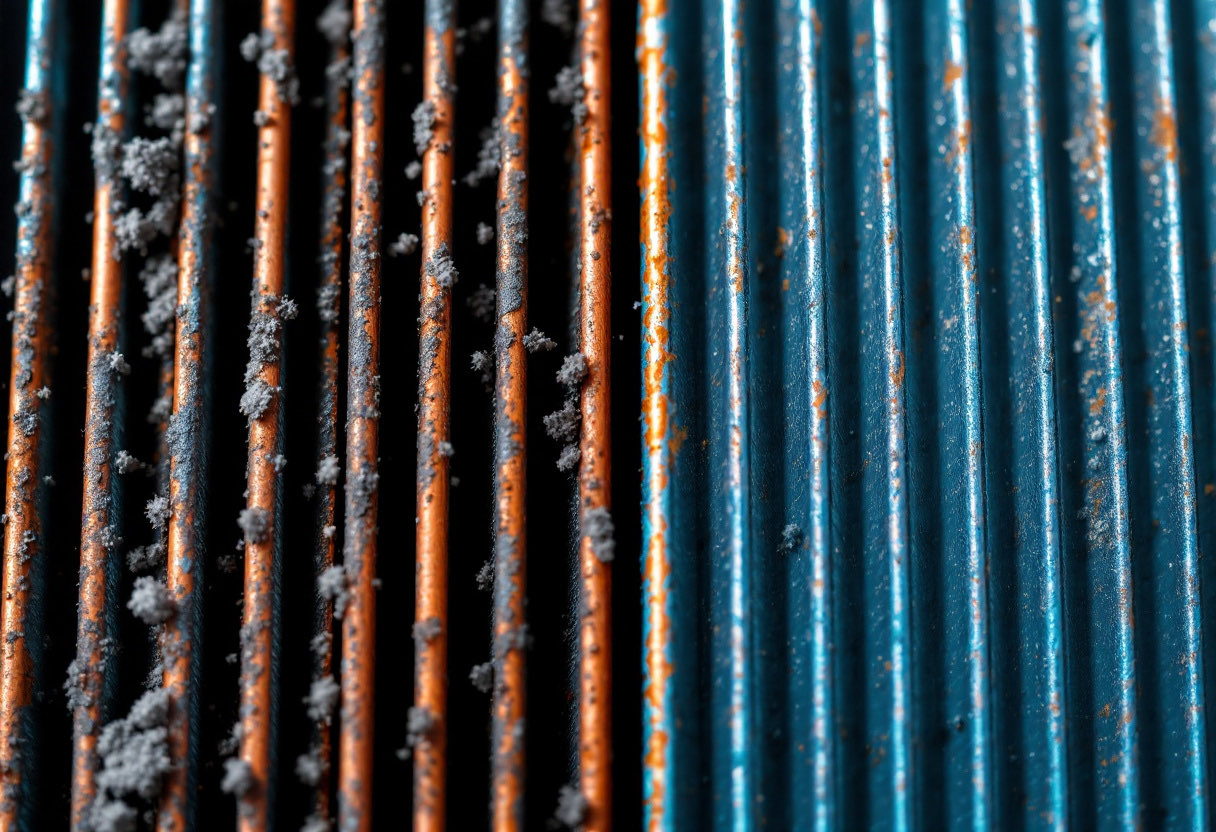
Left: uncoated fins — corrosion and debris insulating the metal, the same barrier every film-forming coating adds on top. Right: SIMIX Ceramic Clearcoat — conductive silica, potassium and lithium instead.
Conducts heat, doesn't trap it
Most coil coatings on the market are insulators — they protect the metal but work against heat transfer. SIMIX's silica-potassium-lithium chemistry pulls heat away from the coil instead.
High, stable pH
Mold, bacteria and pollen live and grow between pH 4.8 and 9.2. Conventional cleaners and coatings sit around pH 7–8.5, right in that range. SIMIX holds a permanent 11.4–12.3.
Independently tested
1,008 hours of cyclic salt fog and UV per ASTM D5894-21, graded by KTA-Tator Inc. — not an in-house claim. Every coated panel returned the best possible D714/D610 rating.
Named case studies
Gilbert, AZ; Waffle House Phoenix; St. Augustine, FL; Park Ridge, IL. Real sites, real before/after figures, linked to source documents — not anonymized "up to X%" marketing.
Works on what you already own
No new equipment, no capital approval cycle. A typical commercial job pays back in 3–9 months versus years of amortized replacement cost.
Safe to apply around people
Water-based, zero VOCs, NSF-registered nonfood compound. Facility staff can apply it without evacuating the space, unlike many solvent-based industrial products.
Clean & coat vs. replace
Try it on one unit before you commit to either
Replacing a rooftop unit is a multi-year capital decision with lead time, disposal and installation downtime. Cleaning and coating the unit you already have is reversible, fast to schedule and inexpensive enough to trial before scaling to a portfolio.
That's why every assessment starts with one unit: measure the split and the bill, then decide whether it's worth extending to the rest of the site.