Why the profile matters
High run hours, or harsh air conditions – usually both
The economics of a coil coating follow two variables: how many hours a year the equipment runs, and how aggressively the surrounding air attacks the surface. Where both are high, the same application returns more. The profiles below are simply where those two curves cross.
01
Data centers
Cooling that never switches off, plus humidity you have to hold inside a band.
02
Large retail and warehouse
Acres of white membrane roof and dozens of rooftop units per store.
03
Cold storage & logistics
Temperature control is the product. Hygiene sits right beside it.
04
High-corrosion sites
Salt air, acid rain and UV, working on assets you would rather not replace.
01 · Data centers
The cooling load that never stops
A data hall has no shoulder season. Thermal management is not a comfort question here — it is uptime, and it runs every hour of the year. That makes coil condition one of the few remaining levers on data center cooling cost reduction once the mechanical design is fixed.
SIMIX leaves a thermally conductive layer on the coil rather than an insulating film, so heat keeps moving off the surface at the rate the design assumed. Because the coating is also hygroscopic, it works with — not against — the humidity band a server environment has to hold.
- Continuous heat rejection on CRAC, CRAH and in-row coils
- Hygroscopic surface behaviour supports humidity management
- Applied in place — no shutdown, no equipment swap
- Lower kWh on the largest non-IT load in the building

02 · Large retail and warehouse
Acres of roof, dozens of units, one repeatable spec
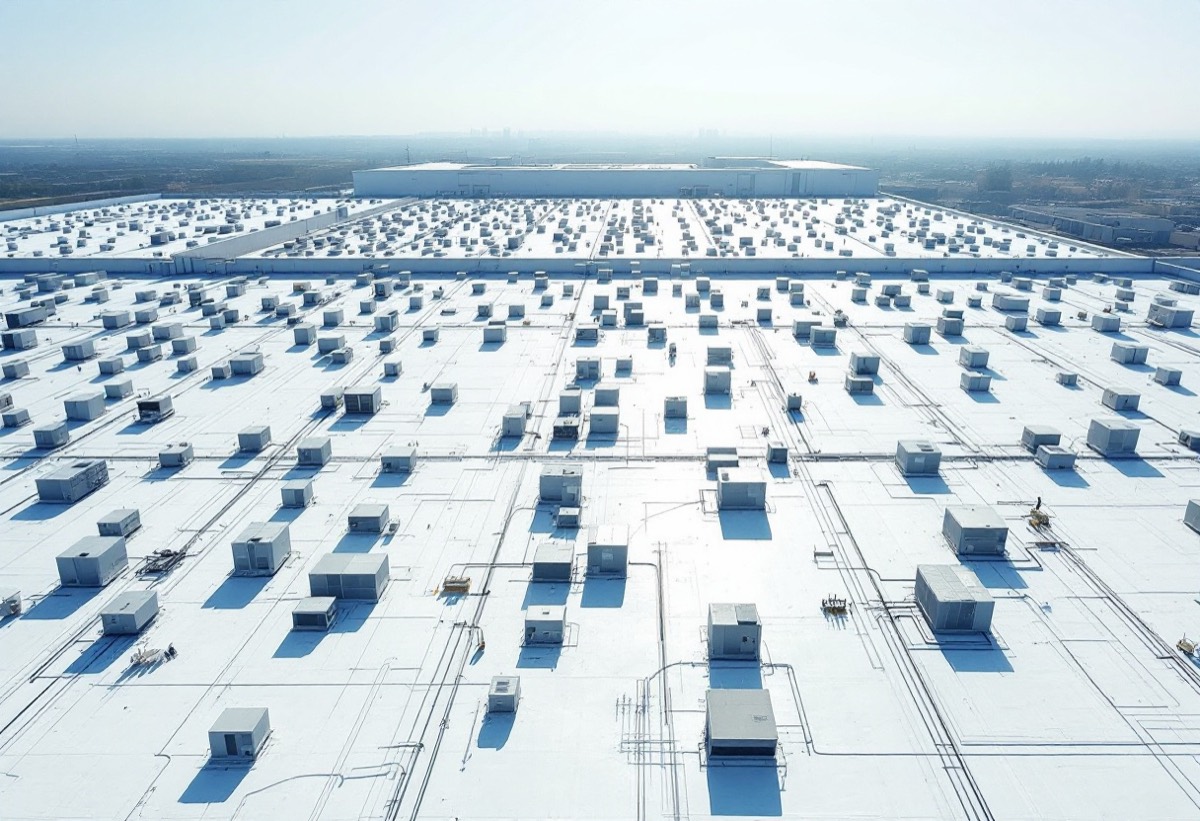
A supercenter carries a white membrane roof measured in acres and a rooftop unit population measured in dozens. Right now that surface is a maintenance liability. Treated, it becomes an asset that works: the SPOT-ON™ titanium dioxide in the clearcoat drives photocatalytic oxidation, so daylight on the roof breaks down airborne pollutants instead of simply baking the membrane.
For a portfolio operator the appeal is repeatability. One spec, applied per store, gives a measurable kWh reduction on the units and a sustainability story on the roof — the shift from passive maintenance to something that counts toward a Scope 1 target.
- One spec that rolls out store by store across a portfolio
- Photocatalytic oxidation turns roof area into a “Pure Air Generator”
- Lower surface temperature on the membrane below the units
- Documented kWh reduction that reports against a Scope 1 goal
03 · Food & fashion logistics, cold storage
Temperature control is the product
In cold storage and temperature-controlled logistics, refrigeration is not overhead — it is the thing being sold. A fouled evaporator costs twice: once in the compressor hours it takes to hold setpoint, and again in every degree of drift the inventory has to absorb.
Cleaning and coating gives back heat transfer on the evaporator, and the finished surface holds a pH high enough that bacteria and mold do not establish on it. For a food or perishables operator that is the same application answering two separate audits: energy and hygiene.
- Restored evaporator heat transfer, shorter compressor run times
- High-pH surface that bacteria and mold do not colonise
- NSF-registered cleaner — nonfood compound categories A1, A4, B2, L1
- Water-based, zero-VOC and fragrance-free around stored product

04 · High-corrosion industrial sites
Stop the replacement clock on ageing equipment
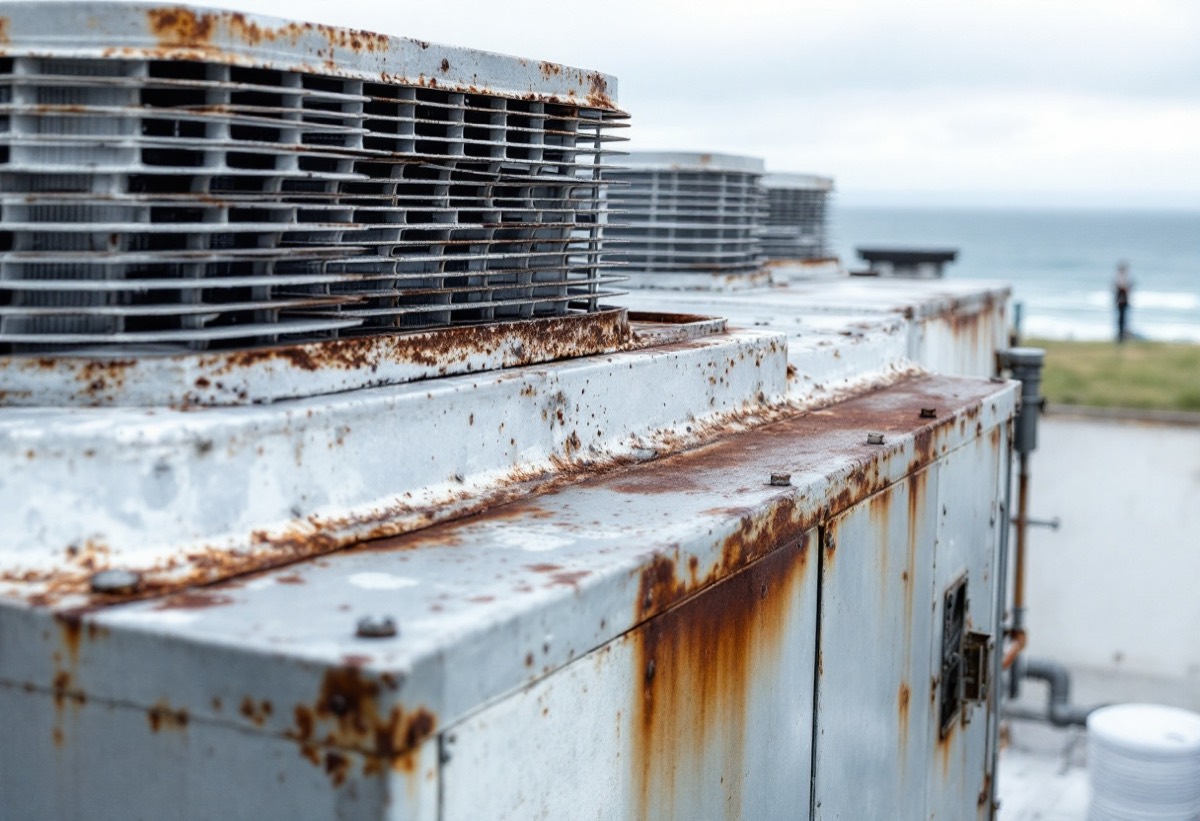
Salt air, acid rain and UV oxidation are what actually kill industrial HVAC — not hours on the compressor. Coastal and heavy-industry sites watch capacity fall year after year, then replace units that had plenty of mechanical life left in them.
SIMIX is at its most valuable on this equipment, because it works as a refurbishment tool rather than a new-build protectant. The coating reflects UV and infrared and seals the microscopic gaps where oxidation starts, which ends the corrosion process on a surface that was already losing. Independent cyclic salt fog and UV testing ran 1,008 hours per ASTM D5894-21, with coated panels graded at the top of both the ASTM D714 blistering and D610 rusting scales.
- Applied to ageing HVAC infrastructure, not just new units
- Ends salt air and acid rain attack on fins and cabinets
- 1,008-hour third-party salt fog and UV exposure record
- Defers a capital replacement that was otherwise being scheduled
Corrosive-conditions sheet — Tampa Bay side-by-side units & test results (PDF) ↓
What every profile shares
The same three numbers
24%
Upper end of site-specific reported kWh reduction · range 12–24%
26%
Upper end of reported airflow gain · range 16–26%
3–9 mo
Typical reported payback on commercial HVAC
Ranges reflect reported results across documented commercial sites. Outcomes are site-specific and vary with climate, equipment age, run hours and utility rate.